Pioneering Study Into Repeated Head Blows in Women's Rugby - What Schools and Clubs Need to Know
A new study is investigating how repeated head impacts affect the female brain in rugby - and why schools and clubs should follow the evidence as it develops.
Pioneering Study Into Repeated Head Blows in Women's Rugby - What Schools and Clubs Need to Know
Key takeaways
- A new study is specifically investigating how repeated head impacts affect the female brain in rugby - the first research of its kind to use a women-specific protocol.
- Female brains are structurally different from male brains, and existing concussion research has overwhelmingly been conducted on male athletes.
- The research gap has real consequences for how concussion is identified and managed in girls' and women's rugby.
- The current universal grassroots guidelines remain the correct framework for schools and clubs to follow now.
- As the evidence base develops, protocols should be reviewed and updated to reflect it - that is how evidence-based practice is supposed to work.
A pioneering study reported by the Guardian on 24 May 2026 is examining how repeated head blows affect the brain in women's rugby, using a women-specific head impact protocol for the first time. The research, also covered by Women's Agenda, highlights something concussion researchers and clinicians have been raising for years: almost everything we know about repeated head trauma in rugby is based on male athletes, and female brains are not the same.
For UK schools and clubs running girls' and women's rugby programmes, this is not an abstract academic concern. It has direct implications for how confident we can be that current protocols are fully fit for purpose across all players - and it is a strong reminder of why protocols need to be treated as living standards, not fixed rules.
What the new study is actually doing
The research represents a meaningful step forward in how scientists approach concussion in women's sport. Rather than applying male-derived assessment tools and return-to-play thresholds to female athletes, the team behind this work has developed a protocol built specifically around the female brain.
The Guardian's report notes that female brains are softer and more vulnerable than male brains, a structural difference that has implications for both the pattern of injury and the recovery process. Previous studies of chronic effects of head trauma in rugby have focused almost exclusively on professional male players. The FIELD study from the University of Glasgow, which found former professional male footballers had a significantly higher rate of neurodegenerative disease, used a male cohort. The emerging rugby litigation cases similarly centre on male professional players.
This new study is asking what happens when you apply the same level of rigour to women. The answers are not yet published, but the question itself marks a significant shift.
Why the research gap matters
The absence of female-specific data has had practical consequences. Concussion recognition tools such as the CRT6, developed and validated through the Concussion in Sport Group, were not designed with sex-based differences in symptom presentation at their core. The UK Concussion Guidelines for Grassroots Sport (Sport and Recreation Alliance, November 2024 update) apply to all participants regardless of sex, which is the right approach for a universal minimum standard, but they do not yet reflect what a female-specific evidence base might recommend.
This is not a criticism of those guidelines. Universal standards based on the best available evidence are exactly what grassroots sport needs. The point is that the evidence base itself has a gap in it, and that gap is now being addressed. When the findings from this and similar studies are digested by the clinical and sporting bodies responsible for the guidelines, we should expect those guidelines to evolve.
What we already know about sex differences in concussion
While the new research is still underway, there is an existing body of evidence worth understanding. The CISG 6th Consensus Statement (2023) acknowledges that female athletes report more symptoms than male athletes after concussion, and that recovery trajectories may differ. Research published in peer-reviewed journals has documented that female athletes show higher rates of headache, fatigue, cognitive symptoms, and emotional changes post-concussion compared to male counterparts in the same sports.
The reasons are contested. Hypotheses include differences in brain structure and white matter, hormonal factors, differences in neck strength and head mass ratios, and - importantly - differences in willingness to report symptoms. The under-reporting problem is no less powerful in female sport than in male sport, but may operate differently.
None of this changes what the guidelines say today. It does, however, reinforce why those guidelines need to be revisited as new evidence arrives, rather than treated as permanent.
The broader picture for girls' and women's rugby
The timing of this research matters. Girls' rugby in the UK is growing. The RFU has reported consistent increases in female participation at school and community level over the past five years. More girls playing rugby means more girls at risk of concussion, and a greater need for protocols that reflect their biology.
World Rugby has acknowledged the gap. Its player welfare research programme has begun to include female athletes more systematically, and the IRFU's tackle behaviour trial, which demonstrated that lowering the legal tackle height reduced concussion rates, included mixed-sex community game data. But the bulk of the research base remains male-dominated.
This study is part of a wider, gradual correction. Schools and clubs do not need to act on incomplete findings before they have been reviewed and incorporated into guidance. What they do need is to stay close to the guidance that follows, and to use a management framework that can be updated as the science develops.
Following the guidelines that exist, while watching for what comes next
The right approach for schools and clubs right now is straightforward: follow the current UK grassroots guidelines, applied consistently to all players, and trust that the bodies responsible for those guidelines will update them as the female-specific evidence matures.
The Luca Safe Concussion Framework is built on current UK guidelines and international consensus. It reflects what the evidence supports today, and Luca's clinical team reviews it as guidelines develop. That is the nature of evidence-based practice - not a fixed rulebook, but a living set of standards that evolves as the science does.
For any school or club running a girls' rugby programme, the foundation is already there. Apply the framework, document the process, and be ready to adapt when the guidance catches up with the research.
Sources
- The Guardian. Pioneering study aims to find out how repeated blows to head in women's rugby affects brain. 24 May 2026. https://www.theguardian.com/education/2026/may/24/pioneering-study-aims-to-find-out-how-repeated-blows-to-head-in-womens-rugby-affects-brain
- Women's Agenda. Researchers develop first women-specific head impact protocol for rugby players. May 2026. https://womensagenda.com.au/latest/researchers-develop-first-women-specific-head-impact-protocol-for-rugby-players/
- Sport and Recreation Alliance. UK Concussion Guidelines for Grassroots Sport (November 2024 update). https://sportandrecreation.org.uk/files/uk-concussion-guidelines-for-grassroots-non-elite-sport---november-2024-update-061124084139.pdf
- Concussion in Sport Group. CISG 6th Consensus Statement on Concussion in Sport, Amsterdam 2022. https://concussioninsportgroup.com/cisg-consensus/
- Concussion in Sport Group. CRT6 and SCAT6 tools. https://concussioninsportgroup.com/scat-tools/
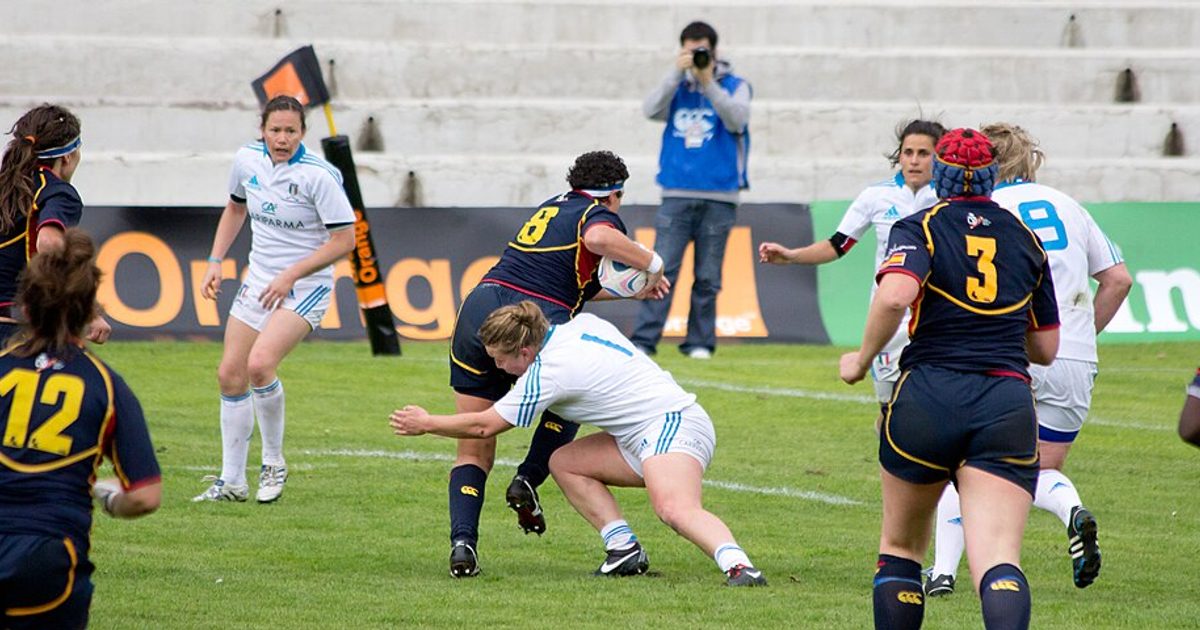
- Photo: Torneo de clasificación WRWC 2014 - Italia vs España by Carlos Delgado, licensed under CC BY-SA 3.0
The Luca Safe Concussion Framework gives schools and clubs a clinician-informed foundation for concussion management that is grounded in current UK guidelines and reviewed as the evidence develops. Download it free and be ready when the guidance evolves.