Phil Vickery Pledges His Brain to Concussion Research - What It Means for Rugby
England World Cup winner Phil Vickery has pledged to donate his brain for concussion research. We explain what the science needs, what it cannot yet tell us, and what grassroots rugby should do now.
Phil Vickery Pledges His Brain to Concussion Research - What It Means for Rugby
Key takeaways
- England World Cup winner Phil Vickery has publicly pledged to donate his brain for CTE and concussion research after his playing career.
- CTE can only be diagnosed post-mortem, so brain donations from former professional players are scientifically critical.
- The pledge adds to growing pressure on governing bodies to treat cumulative head-impact exposure as a welfare priority.
- Research on elite careers does not map directly onto school or grassroots rugby, but it informs the protocols that protect all players.
- Good concussion management at every level, from international to school fixtures, remains the most practical response clubs and schools can take today.
Phil Vickery, England's World Cup-winning prop, has publicly pledged to donate his brain for concussion research after he dies, telling journalists he wants to help scientists understand the long-term effects of a professional rugby career. The news, reported this week by The Telegraph and The Independent, lands at a moment when the relationship between contact sport and brain health is under more scrutiny than at any point in the sport's history. For parents, coaches, and school sports staff, it raises an obvious question: what does elite-level research actually mean for the game most people are playing?
Why brain donations matter to the science
CTE (chronic traumatic encephalopathy) cannot be diagnosed in a living person. The condition, characterised by an abnormal build-up of tau protein in the brain, is identified only through post-mortem neuropathological examination. That single fact defines the entire research challenge.
The Glasgow University CTE research programme, published in part via the 2023 BMJ Open Sport study, has been central to UK understanding of the condition in former rugby players. That work depended entirely on donated brain tissue from former players and their families. Without donations, the sample sizes remain too small to draw robust population-level conclusions. Vickery's pledge, and the wider public conversation it reflects, is therefore not just symbolic. It expands the research resource scientists need to answer questions about exposure thresholds, individual vulnerability, and causal mechanisms.
The Observer's coverage this week also highlighted other former players making similar pledges, framing the issue as a generational reckoning by a cohort who played through an era when concussion was routinely managed with a bucket of cold water and a pat on the back.
What CTE research does and does not tell us
It is worth being precise about what the current evidence establishes and what it does not.
What is established: CTE has been identified post-mortem in a number of former professional rugby players. The Glasgow University research found that former professional rugby players had a higher risk of neurodegenerative disease than matched controls. The FIELD study at the University of Glasgow found elevated rates of dementia, motor neurone disease, and Parkinson's disease in former professional footballers.
What is not established: a direct causal pathway from any specific number of concussions or head impacts to CTE. The condition's prevalence in the general population remains uncertain. And critically, the exposure profile of a professional player, who may absorb thousands of sub-concussive impacts across a decade of full-contact training and match play, is categorically different from that of a pupil who plays one or two school rugby matches per week across a season.
The CISG 6th Consensus Statement (Amsterdam, 2022) acknowledges the association between repetitive head injury and long-term neurological risk while noting that causation has not been definitively established, and that the research base remains weighted toward elite male populations.
Does this change anything for school rugby?
Not directly, and that distinction matters. The risk in a professional career involves years of high-intensity full-contact training, not just matches. A school First XV player will accumulate a fraction of that exposure across their entire school career. Extrapolating elite-cohort findings to school sport without adjustment misrepresents the evidence.
That said, the science has a clear directional message: cumulative head impact exposure is a welfare variable worth managing. The less of it a player absorbs unnecessarily, the lower the theoretical cumulative burden. That logic underpins the rule changes already adopted in UK rugby. The RFU's tackle height law changes, phased in at community and school level from 2023 onwards, are designed precisely to reduce the frequency of head contacts, not merely concussive events.
For school rugby specifically, the practical implications are:
- Every suspected concussion should be managed as a concussion until a clinician says otherwise, using the UK Concussion Guidelines for Grassroots Sport (November 2024 update, Sport and Recreation Alliance).
- The minimum 21-day stand-down for under-18s should be treated as a floor, not a target for getting players back.
- Training sessions should apply the lower tackle height law consistently, not just at matches.
- Schools should document every concussion event and every stage of the graduated return to play, both for the individual's welfare and for the school's governance record.
None of this requires waiting for CTE research to reach firmer conclusions. These are proportionate, evidence-consistent steps any school can take now.
The culture shift behind the pledge
What Vickery's pledge represents, beyond the scientific contribution, is a shift in how former players talk publicly about their health. For decades, professional rugby operated inside a culture that treated playing through injury as a mark of character. The generation who played through that era are now, as a cohort, beginning to reckon with what it cost them.
That culture change matters for grassroots sport too. The biggest obstacle to good concussion management at school and club level is rarely a lack of policy. It is the informal pressure, on coaches, on players, and sometimes on parents, to minimise a head injury and get back on the pitch. Research visibility, and the public conversations it generates, shifts the context in which those decisions get made. When a World Cup winner says publicly that he is worried enough about his own brain to pledge it to science, it becomes harder for a U15 coach to wave off a head knock as "just a clash."
What schools and clubs should take away
The immediate practical action is not to wait for the science to settle. The science is pointing clearly enough in one direction to justify the protocols already in UK guidelines. The question for schools and clubs is whether their management is consistent with those protocols now.
That means having a documented concussion policy, training staff in recognition using the CRT6 tool, applying the graduated return to play with clinical oversight, and keeping records that demonstrate the process was followed.
The longer-term question, which donations from players like Vickery will help answer, is what responsible exposure management looks like across a full playing career. That research will take years. Good concussion management today, at every level, is not a consolation while we wait for it. It is itself part of the answer.
Practical steps for school sports staff
- Confirm your school's concussion policy is aligned with the November 2024 UK Grassroots Concussion Guidelines.
- Ensure every member of sports staff has completed RFU HEADCASE training before the new season begins.
- Apply the lower tackle height rule in training, not just competitive fixtures.
- Document every suspected concussion event and every return-to-play stage - the record is the evidence of your duty of care.
- Review your graduated return-to-play protocol and confirm that clinical sign-off is in place before any under-18 returns to contact.
The research Phil Vickery is contributing to will matter enormously for the sport's future. The management your school puts in place this term matters for the players in front of you now.
If you want to ensure your school's concussion governance reflects the current state of the science, explore the Luca Safe Concussion Framework at /lscf/, which applies UK Grassroots Guidelines as a documented, operational standard.
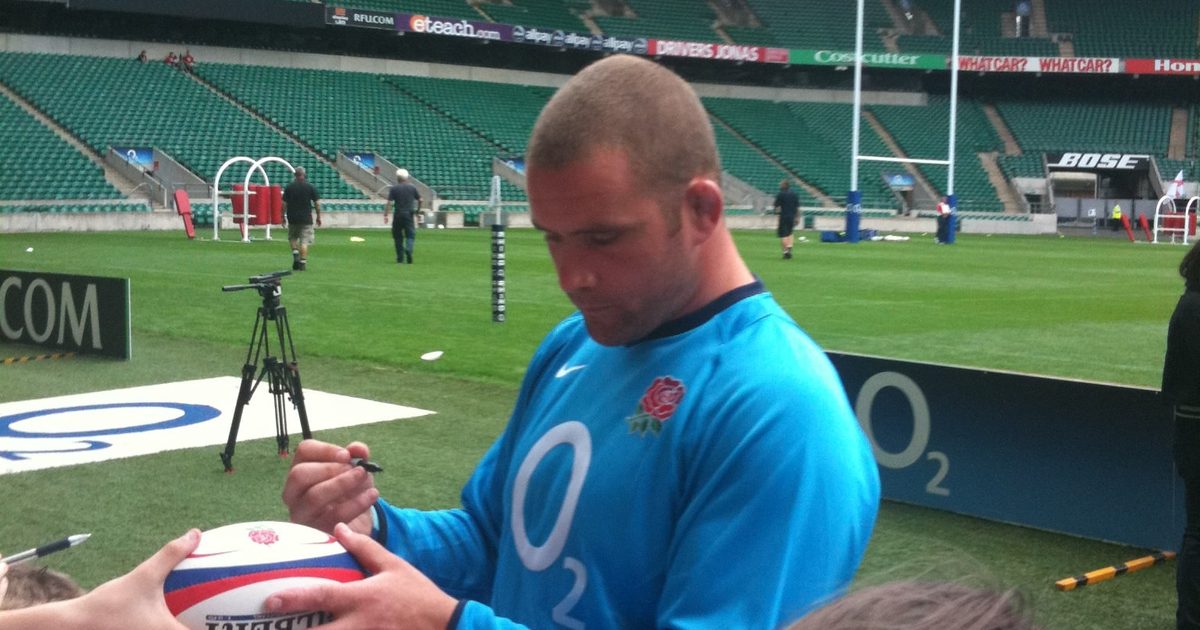
Photo: elyob from Flickr, CC BY-SA 2.0 https://creativecommons.org/licenses/by-sa/2.0, via Wikimedia Commons.
Sources
- The Telegraph. Phil Vickery pledges to donate his brain for concussion research. https://www.telegraph.co.uk
- The Independent. England World Cup winner Phil Vickery pledges to donate brain for concussion research. https://www.independent.co.uk
- The Observer. 'I'll find out how to kill myself so you can use my brain to prove CTE'. https://www.theguardian.com/observer
- University of Glasgow Brain Research. Former professional rugby players: neurodegenerative disease risk. https://www.gla.ac.uk/research/az/brainresearch/
- Patricios JS et al. 6th International Conference on Concussion in Sport: Amsterdam Consensus Statement 2022. British Journal of Sports Medicine, 2023. https://bjsm.bmj.com/content/57/11/695
- Sport and Recreation Alliance. UK Concussion Guidelines for Grassroots Non-Elite Sport (November 2024 update). https://sportandrecreation.org.uk/files/uk-concussion-guidelines-for-grassroots-non-elite-sport---november-2024-update-061124084139.pdf
- England Rugby. HEADCASE concussion awareness programme. https://www.englandrugby.com/run/player-welfare/headcase
- Concussion in Sport Group. SCAT and CRT tools. https://concussioninsportgroup.com/scat-tools/