JJ Hanrahan's Concussion and Munster's Crisis - What Grassroots Rugby Must Know
JJ Hanrahan's concussion has deepened Munster's out-half crisis. Here is what the incident reveals about concussion management in rugby at every level.
JJ Hanrahan's Concussion and Munster's Crisis - What Grassroots Rugby Must Know
Key takeaways
- JJ Hanrahan has been ruled out of Munster's squad after suffering a concussion, adding to an already stretched out-half depth chart.
- In rugby at every level, a confirmed concussion means immediate removal and a minimum stand-down before any return to contact, regardless of how badly the team needs the player.
- Under the November 2024 UK Concussion Guidelines for Grassroots Sport, players aged under 18 must stand down for at least 21 days before returning to contact or competition.
- "The team needs you" is never a reason to skip or shorten the graduated return-to-play protocol - at professional or community level.
- Documented concussion management is the standard grassroots clubs and school teams should be working toward now, not after an incident forces the issue.
What happened with JJ Hanrahan?
Reports from the Irish Examiner confirm that Munster out-half JJ Hanrahan has suffered a concussion, arriving at a moment when the province is already short on options in the number 10 position. The timing is difficult for the coaching staff, but the sporting inconvenience does not change the clinical picture: Hanrahan must follow the same graduated return-to-play protocol that applies to every rugby player, professional or otherwise, before he can train fully or take the field again.
That detail, unremarkable at elite level where medical teams handle it as a matter of routine, is exactly the kind of situation that community clubs and school rugby programmes handle badly when they do not have clear processes in place. The pressure to field the best available player - especially when options are thin - is real at grassroots level too. Understanding how concussion management works, and why it cannot bend to selection needs, is what separates clubs with defensible protocols from those operating on instinct.
What does concussion management look like at professional level?
At professional rugby level, each union operates a Head Injury Assessment (HIA) process for matches. The HIA is a three-stage tool used by team medical staff, pitch-side doctors, and independent match-day doctors working under World Rugby's framework. A player who is removed for an HIA and subsequently confirmed as concussed cannot return to that match and enters a mandatory graduated return-to-play programme before any contact training or competition.
It is worth being explicit: the HIA is an elite-level tool designed for fixtures where a qualified doctor is present on the pitch-side. It is not the protocol that applies to community clubs or school rugby teams.
What protocol applies to grassroots and school rugby in the UK?
For community and school rugby in the UK, the relevant framework is the UK Concussion Guidelines for Grassroots Sport (Sport and Recreation Alliance, November 2024 update). These guidelines apply to all non-elite sport, covering school fixtures, club training sessions, and amateur competitions.
The core principle is the same as at professional level: any player with suspected concussion must be removed from play immediately and must not return that day. But the grassroots protocol is more conservative in several important ways.
For players aged 18 and over, the minimum stand-down before returning to contact or competition is 14 days symptom-free, followed by a graduated return. For players aged under 18, that minimum rises to 21 days before any return to contact. These are floors, not targets. A player still experiencing symptoms at day 21 does not return to contact.
The RFU's HEADCASE resource provides coaches and club volunteers with practical guidance on applying these principles at community level, including what to do in the immediate aftermath of a suspected concussion.
Why does the "team needs you" argument fail?
The Hanrahan situation illustrates something coaches at every level feel acutely: concussion hits at the worst possible moments, to players the team can least afford to lose. At Munster, losing a specialist out-half to a stand-down period creates a genuine selection headache. At a school or community club, the equivalent might be a first-choice captain ruled out before a cup final.
The protocol exists precisely because subjective pressure - from coaches, parents, teammates, and the player themselves - is the single biggest risk factor for premature return. A player who is keen to return, who reports feeling fine, and whose team badly needs them is at higher risk of returning too soon, not lower.
The November 2024 UK Grassroots Guidelines are unambiguous: the graduated return-to-play process starts only after a symptom-free period, proceeds through defined stages, and cannot be compressed because of external circumstances. At each stage, any return of symptoms means stopping and restarting the relevant phase.
Second impact syndrome, while rare, provides the clinical rationale for why the protocol is non-negotiable. A second concussion occurring while the brain is still recovering from the first can have catastrophic consequences, particularly in younger players. Strict stand-down periods are the structural safeguard against this outcome.
What should grassroots clubs take from this?
The professional context makes the principles visible, but the operational challenge is much greater at grassroots level. A Munster team has professional medical staff, documented protocols, and independent oversight. A community club or school team typically has a volunteer welfare officer, a coach with HEADCASE training, and a process that may or may not be written down.
The gap between knowing the rules and having a documented, operational system for applying them is where most clubs fall short. Good concussion management at community level means several things in practice.
First, having a named person responsible for concussion decisions at every fixture, separate from the coaching role. The coach has a conflict of interest when a key player is involved. The welfare officer or designated safeguarding lead should own the removal decision.
Second, recording every suspected concussion incident, including what was observed, who made the removal decision, and when the graduated return-to-play process began. This record is the evidence that a club acted correctly if the decision is ever questioned.
Third, communicating clearly with the player's family (particularly for under-18s) at each stage of the protocol, including at what point return to contact training is being considered.
Fourth, not returning a player to contact before the protocol is complete, regardless of selection pressure.
For schools running rugby programmes, the same principles apply, and the Luca Safe Concussion Framework provides a seven-domain structure that covers identification, removal, management, return to learning, return to sport, documentation, and governance - mapped to the UK Grassroots Guidelines.
The out-half position and concussion risk in rugby
It is worth noting that concussion in rugby is not position-specific. Epidemiological data from World Rugby shows that concussion incidence is broadly distributed across the squad, though forwards involved in scrums, rucks, and mauls have historically shown higher rates. Back-line players including fly-halves are not in a protected position - they are frequently involved in high-speed contact situations and aerial contests.
The point for coaches is that concussion readiness cannot be selective. A club that has robust processes for its front row but no plan for a concussion to its key backs is only partially protected.
Practical steps for clubs and schools this season
The start of the season is the right moment to confirm that the following are in place.
Check that every member of coaching and volunteer staff who is present at training or fixtures has completed HEADCASE awareness training (or equivalent for non-rugby sports). The RFU's HEADCASE module is free and takes under an hour.
Confirm that your club or school has a written concussion policy, that it reflects the November 2024 UK Grassroots Guidelines, and that it specifies who has the authority to remove a player and who manages the graduated return process.
Confirm that you have a system for recording concussion incidents and tracking players through the return-to-play stages. A written log that does not get updated is not a functioning system.
Review your communication process with parents of under-18 players. The guidelines require that parents or guardians are informed when a concussion is suspected in a minor, and that they are part of the return-to-play decision.
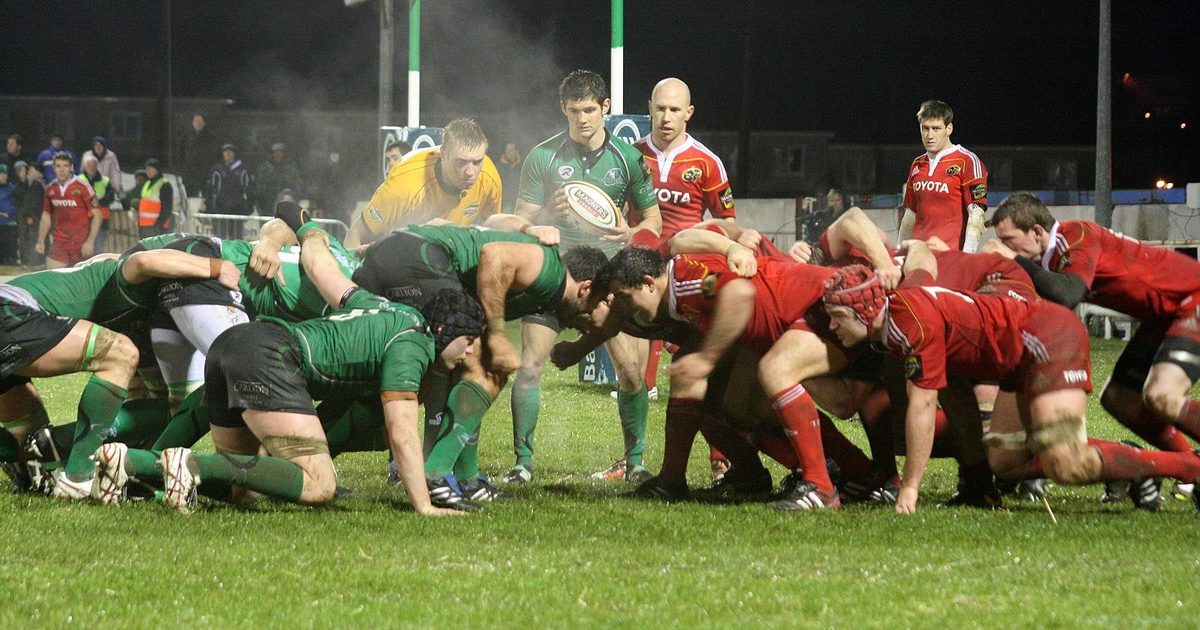
Photo: Eoin Gardiner from Clarinbridge, Ireland, CC BY 2.0 https://creativecommons.org/licenses/by/2.0, via Wikimedia Commons.
Sources
- Irish Examiner. JJ Hanrahan concussion adds to Munster's issues at out-half. https://www.irishexaminer.com
- Sport and Recreation Alliance. UK Concussion Guidelines for Grassroots Sport (November 2024 update). https://sportandrecreation.org.uk/files/uk-concussion-guidelines-for-grassroots-non-elite-sport---november-2024-update-061124084139.pdf
- England Rugby. HEADCASE - concussion awareness for rugby. https://www.englandrugby.com/run/player-welfare/headcase
- World Rugby. Concussion guidance and HIA protocol. https://www.world.rugby/the-game/player-welfare/health-safety/concussion
Clubs and schools looking to build a complete, documented concussion management process can explore the Luca Safe Concussion Framework at /lscf/. It covers all seven domains from identification to governance, is mapped to the November 2024 UK Grassroots Concussion Guidelines, and is free to download. For community rugby clubs managing concussion without pitch-side medical staff, it provides the operational structure that turns good intentions into a defensible record.