Degenerative Brain Disease Found in 31 Rugby League Players - What UK Grassroots Sport Must Know
A new study has found degenerative brain disease in 31 former rugby league players, raising urgent questions about cumulative head impact exposure in community sport.
Degenerative Brain Disease Found in 31 Rugby League Players - What UK Grassroots Sport Must Know
Key takeaways
- A new study published via ABC News has reported degenerative brain disease findings in 31 former rugby league players, adding to a growing body of research linking contact sport careers to long-term neurological harm.
- The findings are drawn primarily from elite, career-level players - a very different exposure profile from community and school rugby league.
- CTE is a post-mortem diagnosis; this research does not allow us to diagnose any living person.
- Good concussion management at grassroots level is the most actionable response available to clubs and schools right now.
- UK clubs and schools should treat this as a prompt to audit their protocols - not as a reason to abandon the sport.
A new study reported by ABC News has identified signs of degenerative brain disease in 31 former rugby league players. The findings add significant weight to the existing evidence base linking repeated head impacts across a professional contact sport career to long-term neurological damage. For UK grassroots clubs, school rugby league coordinators, and parents, this raises a legitimate question: what does it mean for us?
The honest answer requires careful reading of the research - understanding who was studied, what was found, and how far those findings travel from elite dressing rooms to community pitches in Northern England.
What did the study find?
The ABC News report describes degenerative brain disease, consistent with the pathological patterns associated with Chronic Traumatic Encephalopathy (CTE), found in the brains of 31 former rugby league players. The research follows a pattern established by earlier work - including the University of Glasgow's FIELD study on professional footballers and neuropathological research from Boston University - of examining donated brains from former elite athletes post-mortem.
CTE is confirmed only after death, through post-mortem neuropathological examination. It cannot be diagnosed in a living person. This is not a caveat designed to minimise the findings; it is a scientific fact that shapes how any living coach, parent, or player should respond to this research.
The study has not, at the time of writing, been fully published in a peer-reviewed journal with a methodology section available for independent scrutiny. As always with emerging research in this area, readers should distinguish between findings and conclusions, and wait for full publication before treating headline figures as settled science.
Who was studied - and why that matters enormously
The research appears to focus on former professional or high-level rugby league players. This distinction is critical.
Elite rugby league involves decades of contact training and competitive play, often beginning in academy programmes in early adolescence and continuing into the mid-to-late thirties. The cumulative head impact exposure over a 15-to-20-year career is vastly greater than that experienced by a child playing school rugby league for four years, or an adult playing community league on Sunday mornings.
The CISG 6th Consensus Statement on Concussion in Sport (2022) - the international scientific consensus document on this topic - is explicit that exposure matters. Cumulative risk is understood to be a function of years of participation, frequency of contact, and the management of individual concussion events. A school pupil playing one season of tag-modified rugby league has a fundamentally different risk profile from a professional back-rower with 300 first-grade appearances.
That is not a reason for community sport to be complacent. It is a reason to be precise.
What the research does and does not tell us about grassroots risk
What the emerging rugby league research, taken alongside the Glasgow FIELD study and existing CTE literature, reasonably supports:
- Repeated, unmanaged head impacts over a long career increase neurological risk. This is the clearest signal from the cumulative body of research.
- The risk profile at elite level is not directly transferable to grassroots. Exposure, not sport category, is the primary variable.
- Poor concussion management amplifies whatever underlying risk exists. A professional player who was repeatedly returned to play too early - as many were before modern protocols - faced compounded risk. The same logic applies, proportionally, at grassroots.
What this research cannot tell us:
- Whether a specific living player has or will develop CTE.
- Whether the risk associated with community rugby league, where contact volume is lower and sessions are less frequent, is comparable to elite exposure.
- Whether any individual concussion event causes long-term damage in isolation.
How is rugby league exposure different from rugby union and football?
Rugby league and rugby union share contact mechanics but differ in game structure. Rugby league involves more frequent play-the-ball sequences, fewer rucks, and arguably more repeated short-range collision. However, at community level, both codes are subject to the same UK Concussion Guidelines for Grassroots Sport (Sport and Recreation Alliance, November 2024 update), which set the same minimum 21-day stand-down for confirmed concussion in under-18s regardless of sport.
The RFL has its own grassroots concussion guidance and the Concussion Passport scheme, which tracks concussion history across a player's career. These tools exist precisely because cumulative exposure matters - and managing individual events rigorously is the most direct lever available to clubs.
What should UK grassroots clubs and schools do with this information?
This research is not a signal to abandon rugby league. It is a signal to take every concussion event seriously, document it properly, and follow the graduated return-to-play protocol without shortcuts.
Practically, that means:
- Review your concussion policy now. If your club or school does not have a written concussion policy aligned to the UK Grassroots Concussion Guidelines (November 2024 update), produce one before the season progresses further.
- Apply the "if in doubt, sit them out" principle without exception. Any suspected concussion means immediate removal from play - not a sideline assessment followed by return to the same session.
- Follow the full 21-day minimum stand-down for under-18s. The minimum is a floor, not a target. If symptoms persist, the clock does not run.
- Document every incident. A concussion record is not bureaucracy; it is the only way to track cumulative history across a season or across clubs.
- Brief coaches and welfare officers on the research context. They will hear about this study from parents and players. Equipping them to respond accurately - distinguishing elite exposure from grassroots, confirming protocols are in place - is part of good governance.
- Signpost parents to authoritative sources. NHS guidance on head injury and concussion and the UK Grassroots Guidelines are the appropriate starting points for parents with concerns.
If you are a parent with specific concerns about a child who has sustained a concussion, the right step is a conversation with your GP - not a decision based on population-level research about elite athletes.
The honest balance: contact sport benefit and risk
Rugby league, like all contact sport, carries risk. So does inactivity - in terms of physical health, mental health, and the social development that team sport uniquely provides. The research emerging on brain health in former elite athletes is serious and deserves serious engagement. It does not, on current evidence, justify eliminating contact sport at community and school level.
What it justifies - and demands - is rigorous, documented, clinician-informed concussion management every time a suspected concussion occurs. The Luca Safe Concussion Framework translates the UK Grassroots Guidelines into an operational standard that clubs and schools can implement and evidence. That is the proportionate response to this research.
Practical takeaway
If you run a rugby league club or school programme, do three things this week:
- Confirm your concussion policy references the November 2024 UK Grassroots Concussion Guidelines.
- Check that every coach and welfare officer knows the immediate removal protocol and the 21-day minimum stand-down rule.
- Ensure you have a system for recording every concussion event - including the date, the stage of graduated return-to-play reached, and the date of medical clearance.
The research will keep coming. The best response to it is not panic, and it is not dismissal. It is better management, every time, for every player.
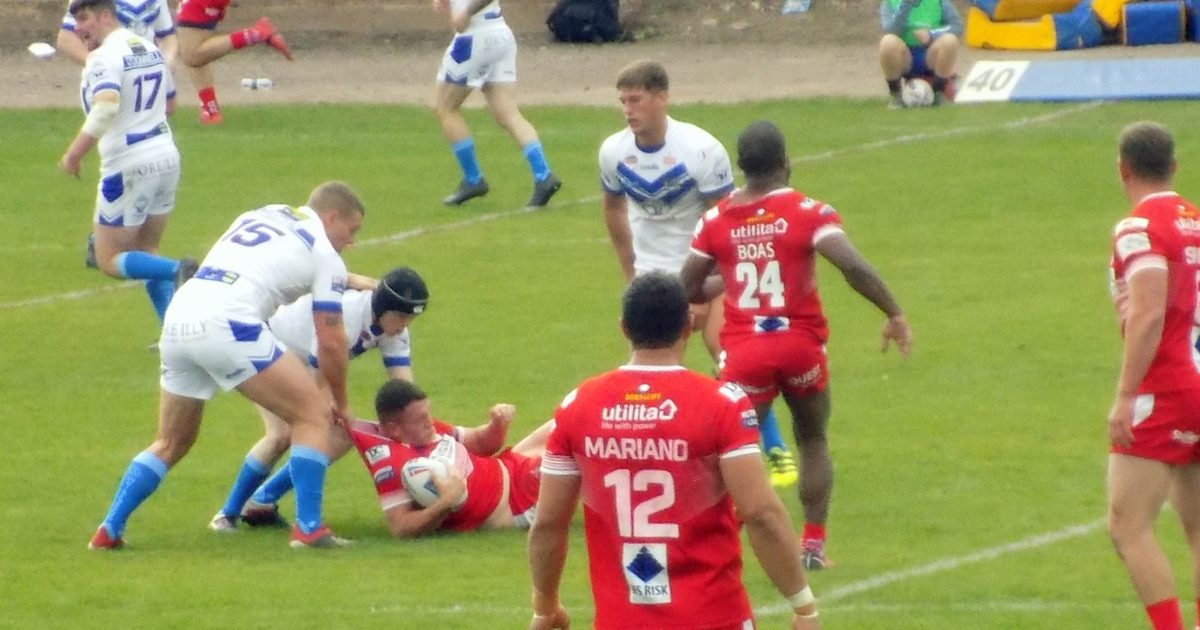
Photo: Jack86mkII, CC BY-SA 4.0 https://creativecommons.org/licenses/by-sa/4.0, via Wikimedia Commons.
Sources
- ABC News Australia. Degenerative brain disease found in 31 former rugby league players. https://www.abc.net.au/news/2026-09-10/degenerative-brain-disease-found-in-31-former-rugby-league/
- Sport and Recreation Alliance. UK Concussion Guidelines for Grassroots Sport (November 2024 update). https://sportandrecreation.org.uk/files/uk-concussion-guidelines-for-grassroots-non-elite-sport---november-2024-update-061124084139.pdf
- Patricios JS, et al. Consensus statement on concussion in sport: the 6th International Conference on Concussion in Sport - Amsterdam, October 2022. British Journal of Sports Medicine, 2023. https://bjsm.bmj.com/content/57/11/695
- University of Glasgow. FIELD study - Football's InfluencE on Lifelong health and Dementia risk. https://www.gla.ac.uk/news/archiveofnews/2019/october/headline_671424_en.html
- NHS. Concussion. https://www.nhs.uk/conditions/concussion/
Long-term brain health research is evolving fast, and the implications for community sport deserve careful, evidence-led reading. The Luca Safe Concussion Framework is built around current UK guidelines and updated as the science develops - giving schools and clubs the operational tools to manage every concussion event to the standard the evidence demands.