Dante Moore's Concussion and the Late-Hit Risk - What Grassroots Sport Must Know
Oregon QB Dante Moore was hospitalised after a deliberate late hit caused a confirmed concussion. Here is what coaches and school sports staff can take from the incident.
Dante Moore's Concussion and the Late-Hit Risk - What Grassroots Sport Must Know
Key takeaways
- Oregon quarterback Dante Moore sustained a confirmed concussion from a deliberate late hit during a college football game against USC on 27 September 2026.
- The offending player, USC linebacker Desman Stephens, was suspended for one game - a decision that has put intentional contact and concussion back in the spotlight.
- In grassroots and school sport, most concussions are not caused by deliberate fouls. But the incident is a sharp reminder that removal and assessment must happen regardless of cause.
- The correct response at grassroots level is the same in every case: remove immediately, do not return to play that day, and follow the UK Concussion Guidelines for Grassroots Sport (Sport and Recreation Alliance, November 2024 update).
- Coaches and school sports staff do not need to determine intent. Their job is recognition and removal, not adjudication.
Oregon quarterback Dante Moore was taken to hospital on 27 September 2026 after sustaining a concussion from a late hit by USC linebacker Desman Stephens in a Pac-12 college football fixture. Multiple outlets including ESPN and Reuters confirmed Moore suffered a concussion; USC subsequently suspended Stephens for one game for what Oregon head coach Dan Lanning described as a "disgusting play." Moore is expected to return later in the season but will not face further structural injury, according to CBS Sports.
The story has circulated widely. For coaches and school sports staff in the UK, the details - a high-profile athlete, a deliberate blow, immediate removal, a hospital visit - raise a set of practical questions worth addressing directly.
What actually happened to Dante Moore?
Moore was struck in the second quarter of the Oregon-USC fixture. The hit was late and deliberate, connecting with Moore after he had released the ball. He left the pitch immediately, was assessed, and was transported to hospital as a precaution. No structural damage beyond the confirmed concussion was reported.
USC suspended Stephens under its own disciplinary process. The disciplinary response is a matter for the governing body of American college football (the NCAA) and USC. What matters for UK grassroots readers is the clinical picture: a significant head impact, immediate removal, clinical assessment, hospital attendance, and a recovery timeline that will be measured in weeks.
Why does a US college football story matter for UK grassroots sport?
Because the questions it prompts are universal. When coaches or sports staff see a head impact - however caused - they face the same decision every time: does this player need to come off?
The answer, under the UK Concussion Guidelines for Grassroots Sport (Sport and Recreation Alliance, November 2024 update), is consistent: if there is any suspicion of concussion, the player is removed immediately and does not return to play that day, regardless of how the impact occurred.
Intent is irrelevant to the clinical decision. A deliberate late hit and an accidental collision produce the same physiological response in the brain. The same protocol applies.
How should coaches identify suspected concussion at the sideline?
This is where the Concussion Recognition Tool 6 (CRT6), published by the Concussion in Sport Group, is the appropriate starting point for non-medical staff. It is designed specifically for coaches, teachers, and sports staff without clinical training. It does not diagnose concussion - it identifies whether removal and further assessment are needed.
The CRT6 covers:
- Red flags that require immediate emergency response (loss of consciousness, seizure, deteriorating conscious state, suspected spinal injury).
- Observable signs - dazed appearance, confusion, balance problems, grabbing the head, crying, slow to respond.
- Memory questions - to assess orientation and short-term recall.
If any of these is present, or if the coach is simply unsure, the player comes off. This is the "if in doubt, sit them out" principle, and it sits at the heart of every major UK and international concussion framework.
You can find the CRT6 tool via the Concussion in Sport Group.
Luca's clinician-led platform supports schools and clubs from first incident identification through to safe return - see how it works at /how-it-works/.
What happens after removal - the immediate steps
Removal is step one. What follows matters equally. Under the November 2024 UK Grassroots Guidelines:
- Do not return to play that day. This is non-negotiable. Even if assessment appears normal, a player who has had a significant head impact does not return to the same session or fixture.
- Inform a parent or carer as soon as possible if the player is under 18.
- Seek clinical assessment. For most grassroots incidents this means contacting NHS 111, the player's GP, or - where red flags are present - attending A&E. This is an individual clinical decision; Luca does not advise on specific cases.
- Begin the graduated return to sport (GRAS) protocol only after clinical clearance, and only after a minimum symptom-free period. For under-18s, the UK guidelines set a minimum 21-day stand-down from the time of injury before return to contact or competition.
The graduated return has six stages, moving from complete rest through light aerobic activity, sport-specific exercise, non-contact training, full contact training, and finally return to competition. Each stage requires 24 hours minimum at that level, symptom-free, before progressing.
Does a deliberate foul change the protocol?
No. The protocol is triggered by the impact and the player's response to it, not by the circumstances of the contact. A coach who is angry about a late challenge - understandably - might be tempted to focus on the foul. The player's welfare requires a different focus: is this person showing signs of concussion?
Disciplinary matters are for referees and governing bodies. Concussion management is for the coach and, where available, a first-aider or medic.
In school and grassroots sport, there is rarely a pitchside medic. The coach is often the first and only person making the recognition call. That is exactly why the CRT6 exists, and why Luca's framework emphasises structured, documented identification as a non-clinical skill that every coach can learn.
What about the player who insists they are fine?
Moore left the pitch without reported resistance - but many concussed players, particularly young athletes, resist removal. They feel fine, they want to keep playing, they do not want to let the team down.
The UK guidelines are unambiguous: the decision to remove a player sits with the coach or team official, not the player. "If in doubt, sit them out" applies even when the player disputes the doubt.
A useful response in the moment: "I can see you feel OK, but I have a duty of care to you and I'm following our protocol. You'll have the chance to prove you're fine through the proper assessment process."
That framing takes the argument off the field of play and onto process, which is where it belongs.
What should UK coaches and school staff take away from this incident?
Three things:
- Concussion recognition is your responsibility regardless of cause. The mechanism - late hit, accidental collision, fall - does not change the protocol.
- Removal and no same-day return are the non-negotiables. Everything else follows from those two actions being taken correctly.
- Documentation matters. Record the incident, the time of removal, who was informed, and what assessment was conducted. That record protects the player and the school or club.
The Moore case will be remembered in the US for the disciplinary response. In UK grassroots and school sport, the more relevant lesson is quieter: head impacts happen across every contact sport, and the response must be trained, consistent, and documented.
Practical steps for coaches and school sports staff
- Download and familiarise yourself with the CRT6 from the Concussion in Sport Group.
- Review the UK Concussion Guidelines for Grassroots Sport (November 2024) - specifically the removal and stand-down sections.
- Make sure your school or club has a written concussion policy that every member of staff with pitch-side responsibility has read and signed off.
- Brief players and parents at the start of each season on the removal protocol, so that no one is surprised when it is applied.
- If your school plays rugby, football, hockey, basketball, or any contact sport, check whether your governing body has sport-specific guidance that builds on the UK Grassroots Guidelines.
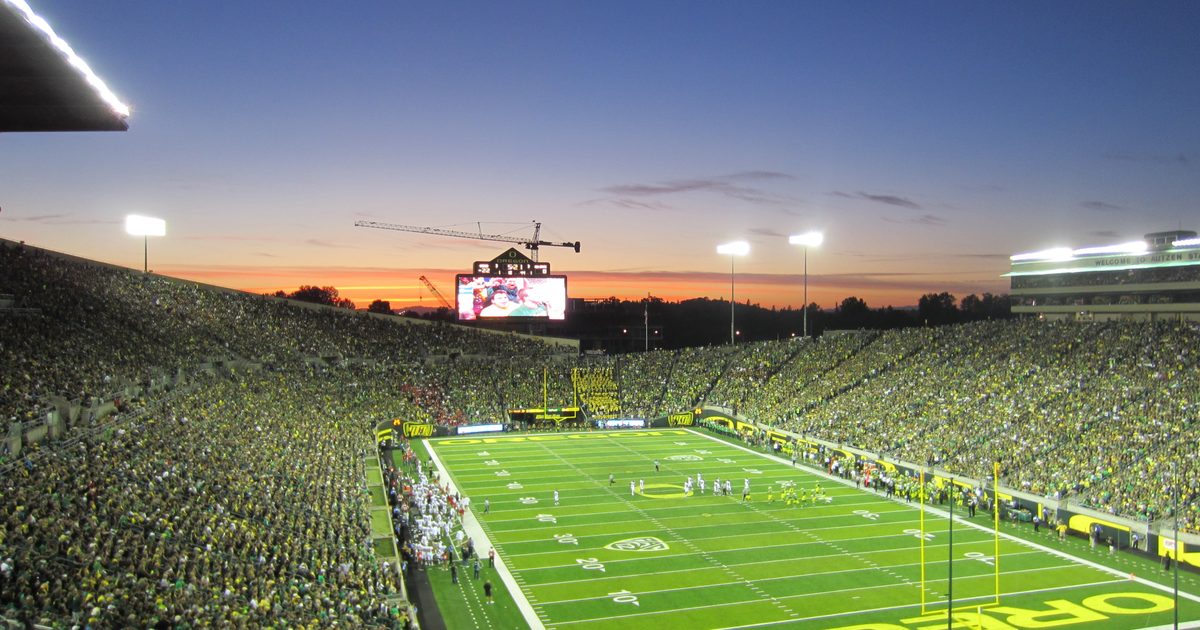
Photo: Another Believer, CC BY-SA 3.0 https://creativecommons.org/licenses/by-sa/3.0, via Wikimedia Commons.
Sources
- ESPN. Oregon quarterback Dante Moore sustains concussion from hit at USC. https://www.espn.com
- Reuters. Oregon QB Dante Moore sustained concussion on late hit vs. USC. https://www.reuters.com
- CBS Sports. Dante Moore injury update: QB suffered a concussion against USC, expected to return later this season. https://www.cbssports.com
- ABC7 Los Angeles. USC suspends LB Desman Stephens for 1 game for late hit on Oregon QB Dante Moore that caused concussion. https://abc7.com
- Sport and Recreation Alliance. UK Concussion Guidelines for Grassroots Sport (November 2024 update). https://sportandrecreation.org.uk/files/uk-concussion-guidelines-for-grassroots-non-elite-sport---november-2024-update-061124084139.pdf
- Concussion in Sport Group. Concussion Recognition Tool 6 (CRT6). https://concussioninsportgroup.com/crt6/
Luca's clinician-led platform supports schools and clubs from first incident to safe return, with structured documentation at every stage of the concussion pathway. See how it works at /how-it-works/.