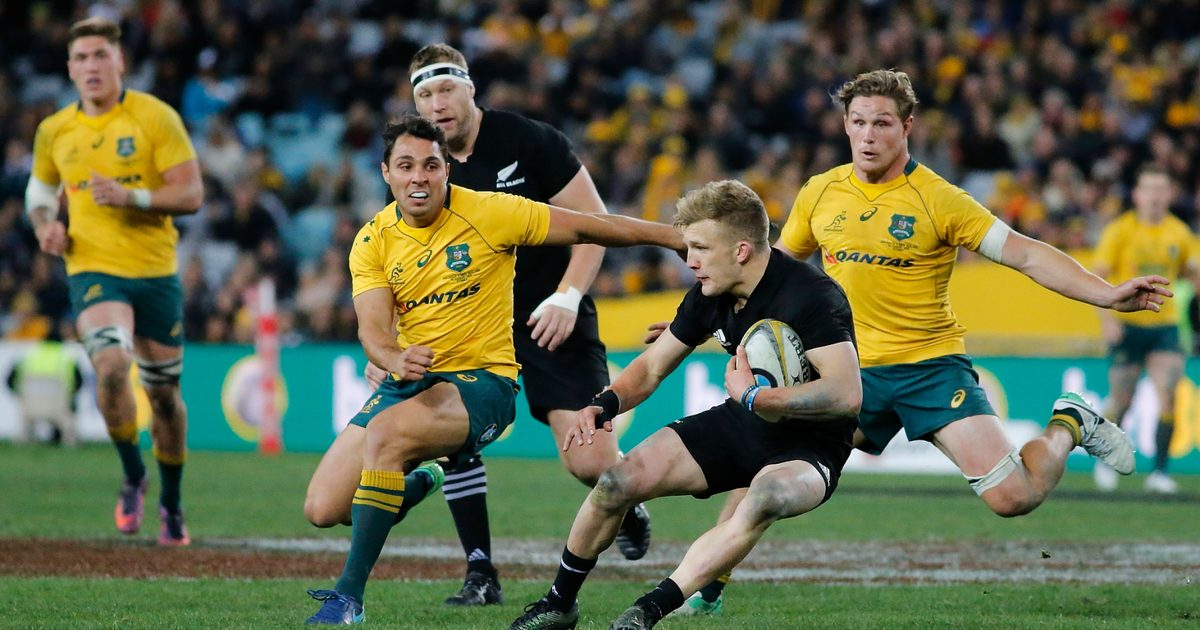
Damian McKenzie's Concussion Stand-Down and What It Means for Grassroots Rugby
Super Rugby medics have recommended Damian McKenzie sit out the rest of the season after a concussion. Here is what the elite decision-making process reveals for school and community rugby.
Damian McKenzie's Concussion Stand-Down and What It Means for Grassroots Rugby
Key takeaways
- Super Rugby medics have recommended Damian McKenzie miss the remainder of the season following a concussion - a call that reflects the same precautionary logic underpinning UK grassroots protocols.
- Elite stand-down decisions are made by independent team doctors; at grassroots and school level, the same principle applies but the mechanism differs.
- The UK Concussion Guidelines for Grassroots Sport (Sport and Recreation Alliance, November 2024) set a minimum 21-day stand-down for confirmed concussion in under-18s and a graduated return process for all ages.
- "If in doubt, sit them out" is not just a slogan; it is the governing principle across elite and community rugby alike.
- Schools and clubs can use high-profile cases as a moment to review whether their own protocols match that same standard.
Reports from Super Rugby this week indicate that All Blacks and Chiefs playmaker Damian McKenzie has been advised to sit out the rest of the Super Rugby Pacific season after a concussion. The recommendation, attributed to team medical staff, illustrates something the rugby community talks about constantly but does not always act on: when medics advise rest, the season ends - regardless of who the player is or what is at stake competitively.
That principle is worth examining carefully, because it applies just as much to a year 10 fly-half at a state school in Lancashire as it does to an international.
What the McKenzie decision actually shows
The detail that matters here is not the identity of the player, but the source of the decision: medical staff, not coaches or club management. In elite rugby, the separation between welfare decisions and selection decisions is now structural. World Rugby's Head Injury Assessment (HIA) protocol is designed precisely to remove coaches from the loop when a player shows signs of concussion.
At grassroots and school level, the equivalent separation is harder to achieve because there is usually no team doctor. The coach is often the only adult present. That is why the UK Concussion Guidelines for Grassroots Sport (Sport and Recreation Alliance, November 2024 update) place the responsibility for immediate removal firmly with whoever is in charge of the team - and make the standard explicit: if there is any suspicion of concussion, the player does not return to the pitch that day.
There is no "let's see how they go" option. The removal is immediate and unconditional.
Why elite stand-downs inform grassroots practice
It would be easy to dismiss a season-ending stand-down for a professional as irrelevant to school sport. The exposure levels, medical resources, and competitive stakes are completely different. But the underlying biology is the same.
A concussed brain - whether it belongs to a Super Rugby international or a 15-year-old playing their first season of contact rugby - goes through the same neurochemical recovery process. The energy crisis in affected neurons, the disrupted axonal function, the period of heightened vulnerability to a second impact: these are not elite phenomena. They are human physiology.
The CISG 6th Consensus Statement (2023) confirms that the period of physiological recovery frequently outlasts the period of symptomatic recovery. Put simply: feeling fine does not mean the brain is ready. That is why McKenzie's medical team would not clear him on the basis of symptoms alone, and it is why the UK grassroots guidelines require a staged return process rather than a simple "symptom-free to play" test.
What do the UK grassroots guidelines actually require?
The November 2024 update of the UK Concussion Guidelines for Grassroots Sport sets out the following minimum requirements for community and school rugby:
- Immediate removal from play on any suspicion of concussion. The player does not return to the field that day under any circumstances.
- Medical assessment as the next step - either through NHS 111, a GP, or (if there are red-flag symptoms such as loss of consciousness, repeated vomiting, or worsening headache) A&E. Luca does not give advice on individual clinical decisions; direct any concern to NHS services.
- A minimum 21-day stand-down from contact for under-18s before any return to full training or match play. This is a floor, not a target - recovery may take longer.
- Graduated return to sport (GRAS), a six-stage protocol in which each stage must be completed symptom-free before progressing. The stages move from complete rest through to full contact training and match play.
- Symptom-free at rest as a prerequisite for beginning the GRAS protocol - not the end of it.
These are not aspirational standards. They are the current published guidance from the Sport and Recreation Alliance, backed by World Rugby, the RFU, the RFL, the FA, and other UK governing bodies.
How does this differ from the elite HIA protocol?
This distinction matters and is worth stating directly: the World Rugby Head Injury Assessment (HIA) used at professional and elite level is not the same as the grassroots GRAS protocol, and the two should not be conflated.
The HIA is designed for elite matches with pitchside medical staff, video review capability, and independent concussion consultants. It includes a 10-minute off-field assessment window and a structured multi-stage in-competition return decision process. It presupposes resources that simply do not exist at most schools or community clubs.
The UK grassroots guidelines are built for the reality of community sport: a coach, a pitch, no doctor. They are more conservative in some respects (the 21-day under-18 minimum has no direct equivalent in the elite HIA pathway) precisely because the safety net of pitchside medical support does not exist.
When you read about McKenzie's stand-down, you are reading about the HIA pathway operating as intended at the elite end. The lesson for schools and clubs is not to copy that process, but to implement the grassroots equivalent with the same seriousness.
The cultural dimension: what elite decisions signal
There is a secondary value in cases like McKenzie's that goes beyond protocol. High-profile stand-downs normalise the idea that concussion management is non-negotiable - that competitive stakes do not override welfare decisions.
That normalisation matters in school and club rugby, where the pressure on coaches and players to minimise concussion and "get back out there" can be considerable. RFU HEADCASE guidance addresses this explicitly, noting that the culture around symptom reporting is as important as the protocol itself. Young players who see professional athletes sitting out seasons when concussed are more likely to report symptoms honestly - because it reframes the decision as normal and responsible rather than weak.
Coaches working with young players can use moments like this as a teaching point. Not to alarm, but to explain: this is how the game now works at every level.
What schools and clubs should do now
If your school or club is running rugby fixtures this term, the following steps are within your immediate reach:
- Confirm that every staff member involved in contact rugby has received adequate concussion awareness training
- Check that your concussion policy references the November 2024 UK Grassroots Guidelines and includes the current 21-day under-18 minimum stand-down.
- Ensure there is a documented process for what happens when a player is removed from play - who contacts parents, how the GRAS protocol is initiated, who has clinical oversight.
- Review your school concussion policy or club framework against current guidance. If it was last updated before November 2024, it needs a refresh.
- Use the Luca Safe Concussion Framework as a benchmark - it implements the UK grassroots guidelines as a documented, operational standard and is free to download.
The McKenzie case is a reminder that good concussion management is not about resources or profile. It is about taking the same decision - remove, rest, graduate return - every time, for every player.
Sources
- Sport Nation. Mark Watson says Damian McKenzie should miss rest of Super Rugby season after concussion. https://news.google.com/rss/articles/CBMiywFBVV95cUxPV04yeTdVbUtNNTNyanhLRy1tUEhGcVpRaUh5cy1oYjJ4a2xISk1sVFZMSHlKQ2R2ek9VWWpocWpPT0xIb0UydWl3QXphMlhUTmpvNnJubWducE9JZG1RLTgyOTFleVdxaWtlSEpLWnJQZVpDSUdrUHRDTEFicGlIS0M5RVB0YzF4cDQ2dzVLVjlrTWFKeGlLUlQ3Sm9iNVcyQ3d0VnJfRWo0VVlNYXAtNzJvRC1sUjM0VWlWRkFKbU9zNjJ1OWxuN1NBVQ
- Sport and Recreation Alliance. UK Concussion Guidelines for Grassroots Sport (November 2024 update). https://sportandrecreation.org.uk/files/uk-concussion-guidelines-for-grassroots-non-elite-sport---november-2024-update-061124084139.pdf
- Patricios JS et al. 6th International Consensus Statement on Concussion in Sport. British Journal of Sports Medicine, 2023. https://bjsm.bmj.com/content/57/11/695
- England Rugby. HEADCASE concussion education. https://www.englandrugby.com/run/player-welfare/headcase Photo: David Molloy Photography / Wikimedia Commons / CC BY 2.0
Luca's platform supports schools and clubs running rugby programmes to implement and document concussion management to current UK guideline standards - from immediate removal through to clinical sign-off on return to play. If you want to see how the framework applies in a rugby context, visit Luca's schools page or the clubs page for more detail.