Repeated Head Blows in Women's Rugby: What the New Research Means for Schools and Clubs
A pioneering new study is examining how repeated head impacts affect the brains of women rugby players - and the findings will matter for every school and club running girls' rugby.
Repeated Head Blows in Women's Rugby: What the New Research Means for Schools and Clubs
Key takeaways
- A new pioneering study is specifically investigating the neurological effects of repeated head impacts in women rugby players, filling a major gap in the existing research.
- Until now, almost all concussion and head-impact research in rugby has used male subjects, leaving women's and girls' rugby managed on extrapolated data.
- The sex-based research gap has real consequences: symptom presentation, recovery time, and risk profile may differ meaningfully between female and male players.
- Schools and clubs running girls' rugby should treat this as a prompt to review identification, reporting culture, and return-to-play documentation now, not once the results land.
- The November 2024 UK Grassroots Concussion Guidelines apply to all players regardless of sex. The minimum 21-day stand-down for under-18s is not gender-conditional.
A new study reported by the Guardian is doing something the sports science community should have done years ago: looking specifically at what repeated head impacts do to the brains of women who play rugby. The research is described as pioneering precisely because the field has been so thin. Most of what coaches, welfare officers, and school sports staff currently apply to girls' and women's rugby is adapted from male-subject data. That matters more than many realise.
This article explains what the study is investigating, what the existing evidence already tells us about sex differences in concussion, and what schools and clubs running girls' rugby should do differently - or more deliberately - right now.
What the new study is actually looking at
The study, covered in detail by the Guardian, is designed to track neurological changes in female rugby players over time, specifically examining the cumulative effect of repeated head impacts rather than single diagnosed concussions. This distinction is important. A player may absorb dozens of sub-threshold head impacts across a season without triggering a formal concussion protocol. The question the researchers are asking is whether that cumulative load still causes measurable changes to brain structure or function in women.
This mirrors work that has already been done in male players, most notably through the University of Glasgow's research into former professional rugby players, which found increased rates of neurodegenerative disease linked to career-long exposure. But that work was conducted almost entirely in men. The new study is attempting to generate an equivalent evidence base for female players, at a time when women's rugby is growing faster than almost any other team sport in the UK.
Why the research gap matters for schools
The absence of female-specific data is not just an academic problem. It has practical consequences for every school fielding a girls' rugby team.
Current concussion management protocols, including the UK Concussion Guidelines for Grassroots Sport (Sport and Recreation Alliance, November 2024 update), are built on a consensus evidence base that is heavily weighted toward male subjects. The protocols themselves are not sex-specific - the same removal criteria, stand-down periods, and return-to-play stages apply to all players. That is the correct approach given what we currently know. But it also means that if female players present with different symptom patterns, or recover on a different timeline, the framework has not been calibrated to catch that.
The CISG 6th Consensus Statement (2023) acknowledged this explicitly, noting that sex is a modifier of concussion recovery and that female athletes may experience more symptoms and longer recovery times in some studies, though the evidence base remains incomplete. It did not recommend different protocols; it recommended more research. That research is now beginning to happen.
What sex-based differences are already documented?
Before this new study reports, here is what the existing literature - however limited - already suggests.
Symptom presentation. Several studies, including research cited in the CISG 6th Consensus, have found that female athletes report higher symptom scores post-concussion than male athletes, including more headache, cognitive symptoms, and emotional symptoms. This may reflect genuine biological differences, differences in reporting behaviour, or both.
Recovery time. Some - though not all - studies suggest female athletes take longer to reach full clinical recovery from concussion. A 2022 paper in Nature Scientific Reports examining post-concussion syndrome in youth found that female adolescents were disproportionately represented among those with prolonged symptoms.
Neck strength. Lower average neck strength in female athletes is one biomechanical hypothesis for why head impacts may cause greater head acceleration, potentially increasing concussion risk or severity. This is an active area of research, not a settled conclusion.
Under-identification. There is evidence, reviewed by the Drake Foundation and others, that concussion in female athletes is more likely to go unidentified. Contributing factors include lower awareness among coaches working in historically less-resourced women's and girls' programmes, and symptom presentations that may not match the stereotypical "got their bell rung" picture coaches are trained to recognise.
What does this mean practically for girls' rugby at school level?
The honest answer is that the new study's results are not yet available. Schools and clubs should not wait for them before acting. The combination of growing participation, a documented research gap, and early signals of sex-based differences in symptom presentation is enough to prompt a review now.
Here are the specific areas worth examining.
Identification training. Does the staff running girls' rugby sessions know that symptoms may present differently in female players, including more headache-dominant and cognitive presentations rather than the dazed, visibly disoriented picture? Refreshing awareness of the CRT6 concussion recognition tool, available free from the Concussion in Sport Group at concussioninsportgroup.com, is a practical starting point.
Reporting culture. Under-reporting is a problem in all player populations, but the evidence suggests it may be worse in female sport, partly due to historically lower resourcing and partly because the culture around "playing through it" in women's rugby has received less explicit challenge. Schools should treat this as a culture question, not just a protocol question.
Return-to-play documentation. The November 2024 UK Grassroots Concussion Guidelines require a minimum 21-day stand-down before full contact return for any player under 18 with a confirmed concussion. This applies equally to girls' and boys' teams, and every stage should be documented. If your girls' rugby programme does not have the same level of documentation as the boys' first XV, that gap is worth closing before an incident makes it consequential.
Baseline testing. If your school conducts pre-season baseline assessments for senior boys' rugby, the same should apply to girls' rugby. Post-injury comparison to an individual baseline is more useful than comparison to population norms, especially if female-specific norms remain underdeveloped.
How does this connect to the broader concussion picture in rugby?
The new study sits alongside a cluster of research developments that are pushing rugby governance to evolve. World Rugby's recommendation in late 2025 to write lower tackle heights into community game law was driven partly by trial data from the IRFU's two-season tackle behaviour study, which found measurable reductions in head contacts when the tackle height law was tightened. Those trials were conducted in the men's game. The question of whether equivalent or greater benefits would apply to women's rugby is one the new study may help answer, at least indirectly.
Schools running girls' rugby alongside boys' rugby should ensure their concussion policy does not treat the girls' programme as a lower-priority afterthought. The same framework, the same documentation standards, and the same removal criteria apply.
For schools looking to build that framework, the Luca Safe Concussion Framework at /lscf/ sets out a seven-domain approach that applies across all sports and all player populations, including girls' and women's rugby.
What to do next: practical steps for schools and clubs
- Review your concussion identification training to ensure it covers symptom presentations more common in female athletes, not just the most visible signs of acute concussion.
- Check that your return-to-play documentation for girls' rugby meets the same standard as your boys' programme. If it does not, bring it in line before the next season.
- Ensure your pre-season baseline testing programme, if you run one, includes all contact sport players regardless of sex.
- Brief your girls' rugby coaches on the emerging research and remind them that the "if in doubt, sit them out" principle from the November 2024 UK Grassroots Concussion Guidelines applies with equal force regardless of sex.
- Watch for the publication of results from this study. The Guardian and academic journals including the British Journal of Sports Medicine are the primary places to follow it.
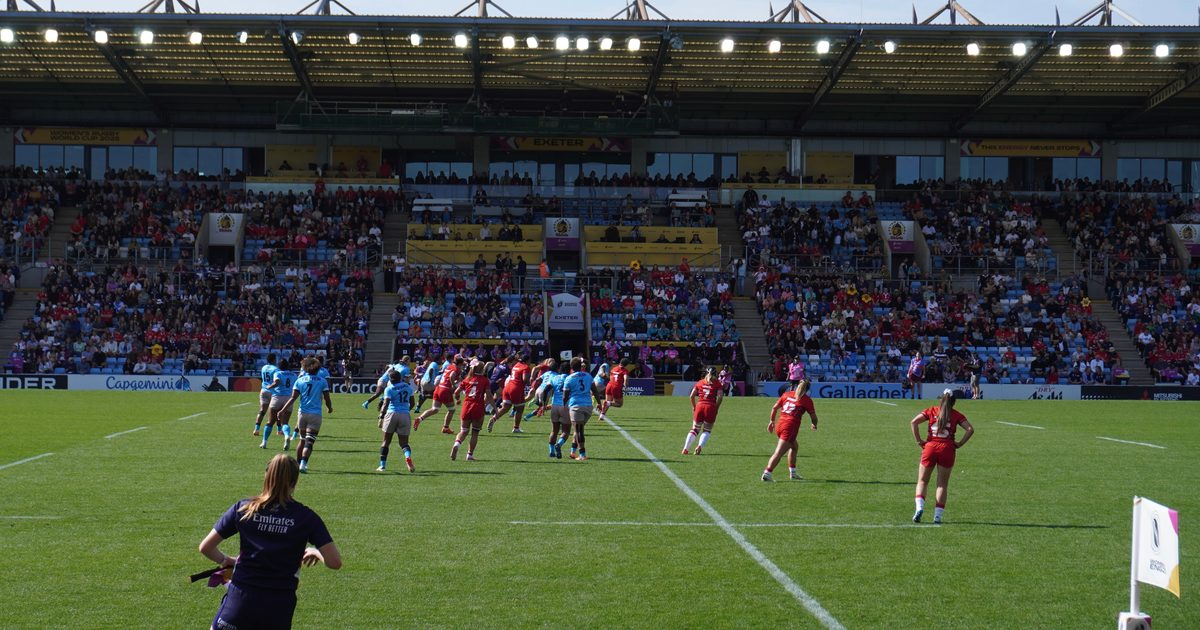
Photo: Spudem, CC BY 4.0 https://creativecommons.org/licenses/by/4.0, via Wikimedia Commons.
Sources
- The Guardian. Pioneering study aims to find out how repeated blows to head in women's rugby affects brain (May 2026). https://www.theguardian.com/sport/2026/may/25/pioneering-study-aims-to-find-out-how-repeated-blows-to-head-in-womens-rugby-affects-brain
- Sport and Recreation Alliance. UK Concussion Guidelines for Grassroots Sport (November 2024 update). https://sportandrecreation.org.uk/files/uk-concussion-guidelines-for-grassroots-non-elite-sport---november-2024-update-061124084139.pdf
- Concussion in Sport Group. CISG 6th International Consensus Statement on Concussion in Sport (2023). https://www.concussioninsportgroup.com
- Concussion in Sport Group. Concussion Recognition Tool 6 (CRT6). https://www.concussioninsportgroup.com/scat-tools/
- Drake Foundation. Female Athlete Concussion Research. https://www.drakefoundation.org
Girls' rugby is growing rapidly in UK schools, and the science behind how female players experience concussion is only now beginning to catch up. The Luca Safe Concussion Framework provides a documented, clinician-led approach that applies consistently across every sport and every player population - including girls' and women's rugby. Download it free and benchmark your current policy today.