Dozens of AFL Players Diagnosed With CTE - What UK Grassroots Sport Must Know
A new ABC report confirms dozens of former Australian Rules footballers have been diagnosed with CTE post-mortem. Here is what the findings mean for UK schools and grassroots clubs.
Dozens of AFL Players Diagnosed With CTE - What UK Grassroots Sport Must Know
Key takeaways
- The Australian Broadcasting Corporation has reported that dozens of former Australian Rules Football (AFL) players have been diagnosed with chronic traumatic encephalopathy (CTE) post-mortem, adding significant weight to the global picture of contact sport and long-term brain health.
- CTE is a post-mortem diagnosis only. No living person can be confirmed to have the condition.
- The AFL findings involve careers of heavy, repeated contact exposure at elite level. That context matters when drawing comparisons with school or grassroots sport in the UK.
- The research reinforces why every concussion at every level deserves proper management, documentation, and a structured return to play.
- UK schools and clubs have access to clear guidelines and frameworks. The question is whether they are using them.
What the ABC report actually says
Australian Broadcasting Corporation reporting published this week confirms that dozens of former AFL players have received CTE diagnoses following post-mortem examination of their brain tissue. The findings come from researchers who have been collecting and studying donated brains from former contact sport athletes in Australia, building on a body of work that mirrors similar programmes in the United States and the United Kingdom.
The ABC also covered the human side of the story, with families describing watching loved ones deteriorate - memory loss, personality changes, and cognitive decline - before their deaths. One family said of their son, who played elite-level Australian Rules from his teens: "Now it's too late."
This is a significant development in the global CTE evidence base. It is not, however, a reason for panic in UK school changing rooms or at grassroots club level. Context is everything.
What is CTE, and how is it diagnosed?
Chronic traumatic encephalopathy is a progressive neurodegenerative disease associated with repeated head trauma. It is characterised by the abnormal accumulation of tau protein in the brain. Symptoms in life can include memory problems, impulsive behaviour, depression, and cognitive decline, though these symptoms overlap considerably with other conditions.
The critical point, repeated here because it matters: CTE is diagnosed only through post-mortem examination of brain tissue. It cannot currently be confirmed in a living person, though research into in-vivo detection methods is ongoing. Any claim that a living athlete "has CTE" is inaccurate.
The CISG 6th Consensus Statement on Concussion in Sport (2023) addresses long-term effects and notes that while a statistical association between repeated head trauma and neurodegenerative disease has been established in some populations, causation and dose-response relationships remain active areas of research.
Who was actually studied - and why that matters for UK readers
The AFL players diagnosed with CTE in the ABC report were predominantly former elite athletes who played many seasons of senior contact sport, often from a young age through to their mid-30s or beyond. Their cumulative head impact exposure across a career is vastly different from that of a 15-year-old playing school rugby union on a Saturday morning, or a Year 9 pupil in a school football fixture.
The Glasgow University FIELD study, published in 2019 and subsequently updated, found that former professional footballers in Scotland were approximately three and a half times more likely to die of neurodegenerative disease than age-matched members of the general population. Again, the cohort was professional footballers with long careers, not school or grassroots participants.
This distinction is not a reason to dismiss the research. It is a reason to interpret it carefully. Cumulative exposure is the key variable. Elite career exposure is orders of magnitude greater than school or community sport exposure, and the science does not currently support a direct extrapolation from one to the other.
What does this mean for CTE research globally?
The AFL findings are significant because they broaden the sports base. CTE has been most widely documented in American NFL players - the Boston University CTE Center has examined hundreds of donated brains. The Glasgow work extended findings into football (soccer). Australian researchers are now adding AFL to the picture.
What emerges across these datasets is a consistent association between high-level, long-term contact sport careers and elevated neurodegenerative risk. The question researchers are working to answer is where on the exposure curve risk becomes meaningful. That question has not yet been definitively answered.
For UK grassroots and school sport, the honest position is: the risk from school-level participation appears materially lower than that documented in elite career studies, but the science does not give us a precise threshold, and good management of every concussion is the rational response to that uncertainty.
What the evidence does not support
It is worth being explicit about what this research does not tell us, because misreading it has real consequences for young people's access to sport.
The AFL diagnoses do not mean:
- That every child who plays contact sport will develop CTE.
- That a single concussion causes CTE (the association is with repeated, cumulative trauma over long periods).
- That school sport is as risky as a professional career spanning 15 or more seasons.
- That contact sport should be banned for young people. The physical, social, and mental health benefits of sport are well-documented, and any proportionate response must weigh these against risk.
The CISG 6th Consensus is clear that the relationship between concussion and long-term neurological disease is not yet fully characterised, and that sport at community level carries different risk profiles from elite sport.
What good concussion management contributes
None of the uncertainty about long-term risk is a reason for inaction. Quite the opposite. The rational response to incomplete evidence is to manage what can be managed rigorously. That means:
- Identifying suspected concussion promptly and removing the athlete from play immediately.
- Following a structured graduated return to play (GRTP) process that gives the brain adequate recovery time before re-exposure to contact.
- Documenting every concussion event so that cumulative history is visible to every coach, school, and clinician involved in the athlete's care.
- Applying the minimum 21-day stand-down for under-18s required by the UK Concussion Guidelines for Grassroots Sport (Sport and Recreation Alliance, November 2024 update).
Each of these steps reduces the brain's cumulative trauma burden, both by preventing second-impact events and by ensuring that return to contact happens only after genuine neurological recovery - not just when symptoms have cleared.
The honest balance for parents weighing school sport
The AFL story will inevitably reach parents of children who play contact sport. Some will ask whether their child should stop playing rugby, football, or Australian Rules. That is a legitimate question and deserves a serious answer.
The honest answer is that the evidence base currently justifies heightened vigilance and robust management protocols at school and grassroots level. It does not currently justify removing children from contact sport wholesale, and doing so would impose real costs - loss of physical fitness, social connection, mental wellbeing, and the character development that sport provides - on the basis of risk data drawn primarily from elite professional careers.
What the evidence does justify, clearly, is the expectation that every school and club takes concussion management seriously. Not as a box-ticking exercise, but as a genuine commitment to reducing cumulative head trauma where it can be reduced, and managing every incident that occurs.
What UK schools and clubs should do now
The arrival of more CTE research from Australia is a prompt to check whether your own house is in order. Concrete steps:
- Review your concussion policy against the November 2024 UK Grassroots Concussion Guidelines. If your policy has not been updated since the November 2024 revision, it needs updating now.
- Ensure every member of staff involved in sport knows the "if in doubt, sit them out" principle and is confident applying it, including when a player or parent pushes back.
- Document every concussion event. Cumulative history matters. A player who has had three concussions in two years is not the same clinical picture as one experiencing a first incident.
- Follow the full graduated return to play process. Symptom-free is not the same as ready to play. The UK guidelines are clear on minimum timelines.
- Talk to parents. A brief note home after any suspected concussion, explaining the management process and what to watch for, builds trust and keeps families as partners in recovery.
The Luca Safe Concussion Framework translates the UK Grassroots Guidelines into an operational standard for schools and clubs, covering all seven domains of concussion management from identification through to documented return to play.
Practical takeaway
The AFL CTE findings are another data point in a body of evidence that is growing, not shrinking. UK schools and clubs should take them seriously - not by alarming parents or banning sport, but by ensuring that every concussion is managed properly, every time. The guidelines exist. The frameworks exist. The remaining question is implementation.
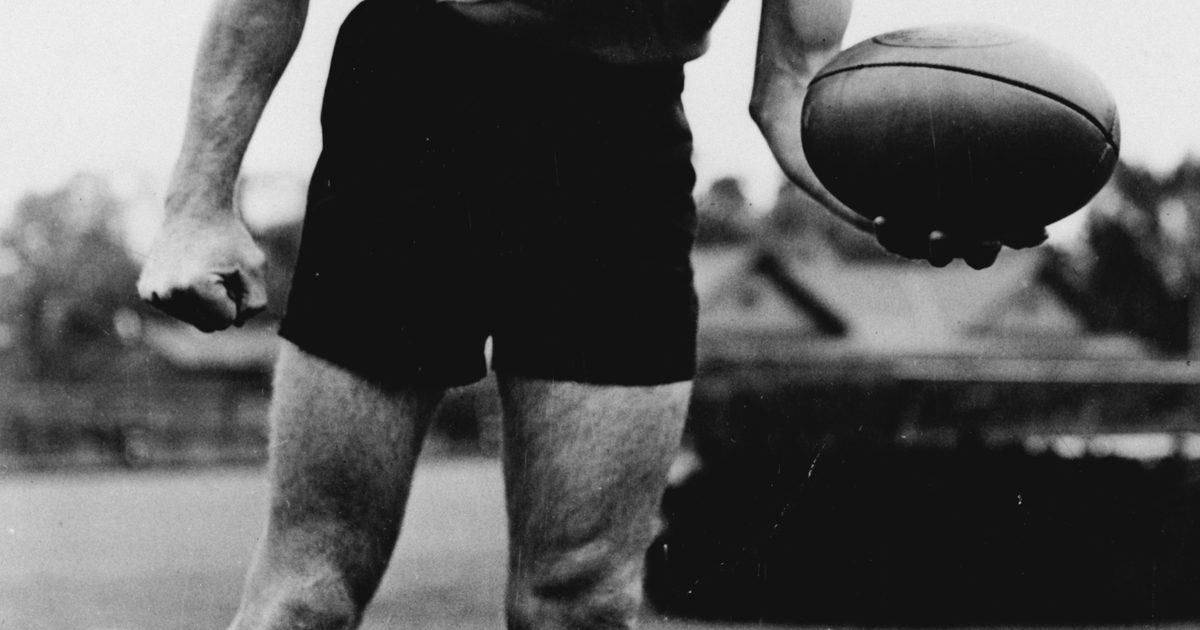
Photo: Unknown authorUnknown author, Public domain, via Wikimedia Commons.
Sources
- Australian Broadcasting Corporation. Dozens of former Australian Rules footballers diagnosed with CTE. https://www.abc.net.au (published June 2026)
- Australian Broadcasting Corporation. They didn't know what footy was doing to their boy. "Now it's too late." https://www.abc.net.au (published June 2026)
- Sport and Recreation Alliance. UK Concussion Guidelines for Grassroots Sport (November 2024 update). https://sportandrecreation.org.uk/files/uk-concussion-guidelines-for-grassroots-non-elite-sport---november-2024-update-061124084139.pdf
- Patricios JS et al. 6th International Consensus Statement on Concussion in Sport. British Journal of Sports Medicine, 2023. https://bjsm.bmj.com/content/57/11/695
- Mackay DF et al. Neurodegenerative Disease Mortality among Former Professional Soccer Players. NEJM / FIELD Study, University of Glasgow, 2019. https://bjsm.bmj.com/content/53/23/1576
- Boston University CTE Center. What is CTE? https://www.bu.edu/cte/about/what-is-cte/
As CTE research continues to develop, the case for rigorous, documented concussion management at every level of sport grows stronger. The Luca Safe Concussion Framework gives UK schools and clubs a practical, clinician-developed structure that reflects current guidelines and the realities of grassroots sport. Download it free and benchmark your own approach today.